Start here
A Home Survey Level 2 is one of the best-value purchases in the whole house-buying process — but it is not an X-ray. Understanding what a survey genuinely can and cannot see will save you two kinds of grief: unrealistic expectations before the inspection, and unnecessary panic after it.
- Behind furniture
- Under fitted carpet
- Services: seen, not tested
- Hatch painted shut
Contents5 sections
The ground rules: visual and non-invasive
A Level 2 survey is a visual inspection of the accessible parts of a property. Your surveyor does not own the house on inspection day — the seller does — so nothing gets opened up, unscrewed, lifted or dismantled. No floorboards come up, no plaster comes off, no fitted wardrobe gets moved.
That is not laziness or small print. It is the legal and practical reality of inspecting someone else’s home, and it is the same for every surveyor working to the RICS Home Survey Standard.
The classic blind spots
Under fitted floor coverings. A carpeted floor can be inspected for level, spring and damp smell — but the boards beneath stay hidden. Where there is a hatch or a corner of loose carpet, a good surveyor uses it.
Inside walls. Wall construction is read from thickness, age, pattern and external evidence. What is happening inside a cavity is inferred, not observed — a borescope helps where there is already an opening, but nobody drills the seller’s wall.
Behind furniture and stored goods. The wall behind a full-height bookcase, the corner of the garage stacked with boxes — if it cannot be seen, it cannot be reported, and the report will say so.
Roof spaces with no safe access. Where there is a hatch and safe access, the roof space gets inspected. Where the hatch is painted shut or opens above the stairwell, the report records the limitation.
Services. Wiring, gas and plumbing are looked at, not tested. A surveyor will note a fuse board that looks original to 1974 and recommend an electrical test — but the survey is not that test.
From the survey archive
Inside the roof space.
Rafters, masonry, insulation and boarding.
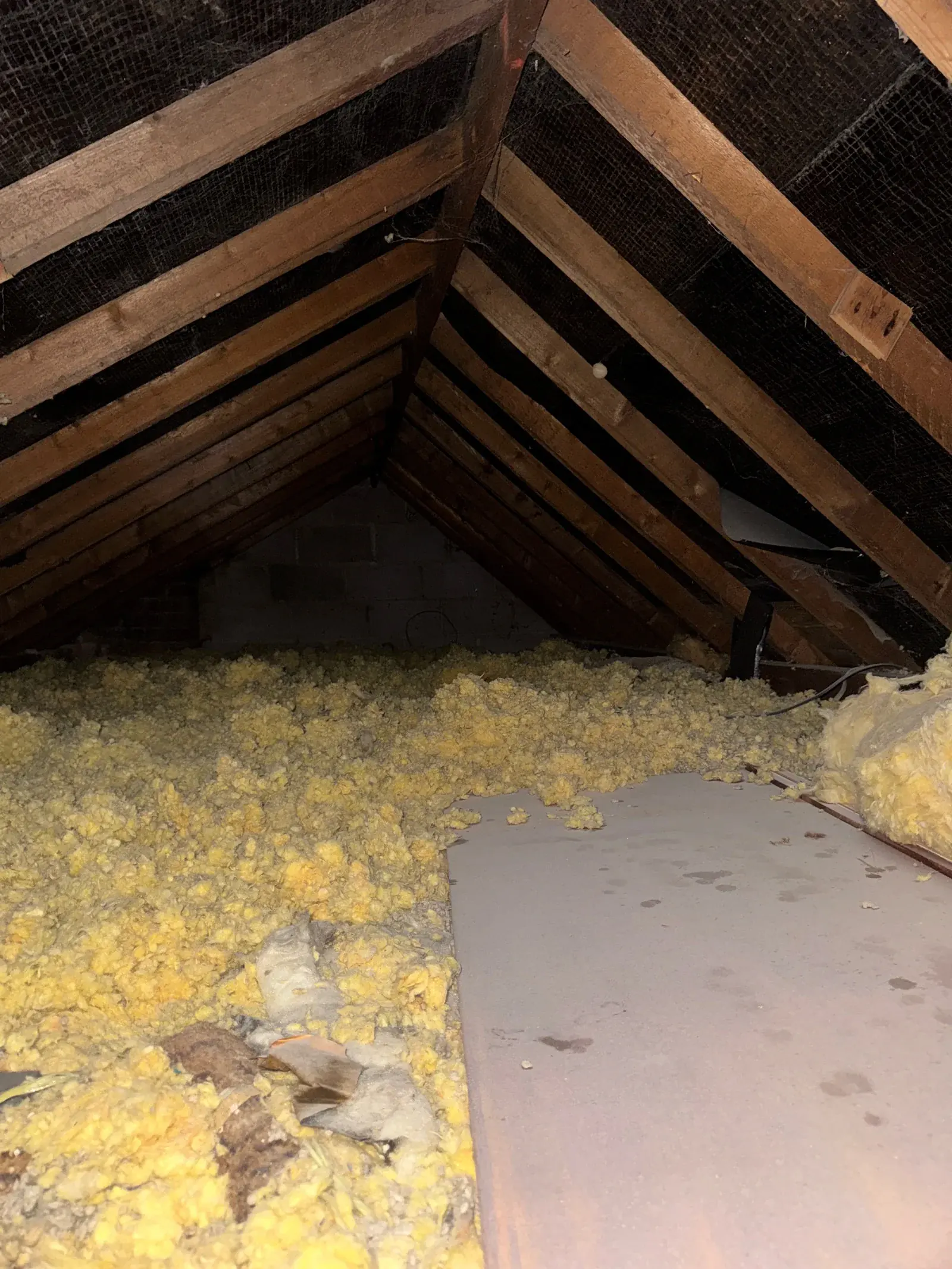
Roof timbers and loft insulation
Rafters, masonry, loose insulation and a boarded area in the roof space.
Photographs from our survey archive.
Explore the full photograph collectionWhy the limitations are in the report
Read a survey report and you will find each limitation recorded — which rooms had heavy furniture, whether the loft was entered, what could not be seen. Some buyers read this as arse-covering. It is actually information: every recorded limitation is a question you can pursue before exchange.
The report also flags follow-on investigations where the visible evidence justifies them: an electrician’s test, a drainage camera, a damp investigation. That is the system working, not failing — the survey is the reconnaissance that tells you where deeper checks are worth their fee.
What a good surveyor does about blind spots
Blind spots are managed, not shrugged at:
- Evidence trails. Damp rarely stays hidden — it stains, smells, lifts paper and corrodes fixings nearby. A surveyor reads the visible edges of an invisible problem.
- Age and pattern knowledge. Knowing what a 1930s semi or a stone terrace usually hides means the inspection targets the right places — and the report asks the right questions.
- Straight talk about risk. Where something couldn’t be seen and matters, the report says what to do about it: ask the seller, get the paperwork, commission the test, or budget for the unknown.
The honest conclusion
A Level 2 survey tells you what the accessible evidence shows, flags what it cannot show, and tells you which unknowns are worth chasing. That is exactly what you want before committing hundreds of thousands of pounds — not false certainty, but a clear map of what is known, what is not, and what to do about the difference.
If a surveyor ever promises to see everything, treat that promise the way you would treat a builder’s quote written on a napkin.
Further reading: what a surveyor actually looks for, room by room, and how to check your surveyor is properly qualified.
Related service
The most popular survey for standard homes: condition ratings, maintenance advice and the matters to raise before exchange. Survey only, without valuation.
Level 2 from £335
About this serviceRequest a Level 2 survey quoteOr call 01484 218579
RICS-regulated firm no. 9317773
Free tools